Monday, February 27, 2017

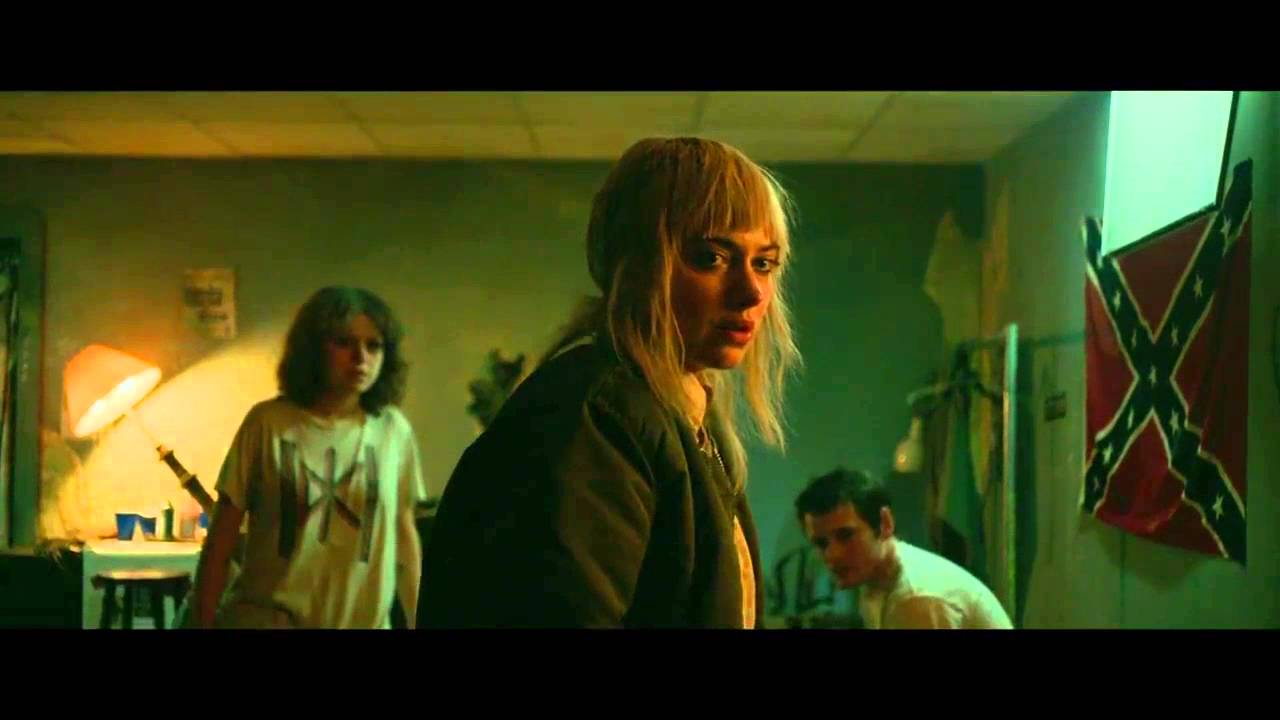
Green Room (2015) ****


If you thought Oregon was just hippies and homebrewers, think again. The Pacific Northwest has a thriving White Supremacist scene. “Green Room” is a smart, backwoods horror flick about a punk band that runs afoul of some of these Neo-Nazis.

Living desperately from gig to gig, siphoning gas to keep their van going, and sleeping wherever they can, the punk band, the Ain't Rights, can't really afford to say no to a paying gig. They are leery of an offer to play a rural,White Supremacist venue, but they are assured they will be out before dark, and skinheads are really nothing new to a punk band, anyway. When a member of the band witnesses a murder, however, things get complicated. The Ain't Rights find themselves hostage, locked in a dressing room. While the skinheads, led by a chilling Patrick Stewart, figure out what to do with them, the band try to figure out an escape, assisted by the dead girl's friend (Imogen Poots).

“Green Room” earns a hard-R rating for the kind of violence that will give you nightmares. It isn't just the gore that will get your heart rate up, the constant menace is terrifying. Don't expect everyone to make it out alive or un-mangled. For those willing to deal with some serious horror, however, you are in for a treat. This is a smart, thrilling horror flick, beautifully filmed, with excellent performances. Patrick Stewart is terrifyingly convincing as the head neo-Nazi, and not just because of his shaved head. Anton Yelchin, who played Chekov on the new Star Trek movies and died this past year, is outstanding.

By definition, characters in horror movies make bad decisions. The difference between good and bad horror is whether those bad decisions are character-driven or plot-driven. Character-driven decisions are made by characters who have been developed so that their mistakes make sense for that character and that situation. Plot-driven decisions, the product of lazy storytelling, are frustratingly nonsensical, and only occur because the progression of the plot demands them. In “Green Room,” the characters do some stupid things, but they are the kind of stupid things young,inexperienced people might do. Their bad decisions are character-driven, and that's what elevates this film above its genre.


4 stars out of 5

Sunday, February 05, 2017

Everybody Wants Some!! (2016) ***


“Everybody Wants Some!!,” the newest film from Richard Linklater, has been touted as a spiritual sequel to the 1993 classic “Dazed and Confused.” It is not a true sequel, in that none of the “Dazed and Confused” characters appear, but rather a film in the same vein, about a bunch of young people experiencing high times to good music. Where “Dazed and Confused” followed several different characters on the last day of high school, “Everybody Wants Some!!” is all from the perspective of a baseball hotshot named Jake (Blake Jenner) as he shows up to start college. In the wild, move-in weekend before classes start, Jake gets to know his new baseball teammates, gets hazed by them, and parties with them at various bars and houses. He also meets a cute chick.

“Dazed and Confused” became a classic, in part because it viewed this single day of high school from so many different perspectives. You got to hang out with jocks, brains, stoners, and cheerleaders, and the takeaway was “We're all kind of the same.” “Everybody Wants Some!” takes a swing at that universality, as Jake and his friends party with punks one night, theater people the next, but they only scratch the surface. This movie is funny, and well worth watching, but it's no classic. Still, you'd have to have a heart of stone to dislike this film about a bunch of buff, young jocks hooking up with sexy chicks, to a soundtrack of classic rock, disco, punk, old-school rap, and even some country. The movie truly has something for everyone.


3 stars out of 5

Sunday, January 29, 2017

Bad Moms (2016) ***


Psychologists have a concept called “Good Enough Parenting,” which states that kids don't need perfect parenting. They just need a certain amount of love and care, and anything beyond that doesn't provide any additional benefit in terms of life success, mental health, etc. It's hard for parents to accept that, though. We always think that if we could spend a little more quality time, provide a little more enrichment, and push a little more for academic success, that all that work will produce a proportionally better outcome for our kids. The pressure is enormous to do MORE, and it seems to fall most heavily on the moms.

In “Bad Moms,” Mila Kunis plays Amy, a mother whose efforts to run her kids around to activities, do their school projects for them, and work a part-time job, while remaining active in the PTA are driving her to exhaustion. When she catches her husband (David Walton) having an online affair, it's the last straw. Amy has a meltdown at the PTA meeting, which puts her at odds with power-mom Gwendolyn (Christina Applegate), but wins her a couple of new friends, Carla (Kathryn Hahn) and Kiki (Kristen Bell.)

With her new compadres, Amy decides to pursue a new ethos. Since nothing they do ever seems to be enough to qualify them as “good moms,” they should just celebrate being “bad moms.” The ladies indulge in microrebellions like daytime movie breaks, making the kids fix their own breakfasts, and hiring the occasional babysitter. Small as these transgressions seem, they wind up costing Amy her exploitative, part-time job and they trigger all-out war with Gwendolyn. Amy winds up challenging Gwendolyn for the PTA presidency, becoming a champion for imperfect moms everywhere.

Written and directed by Jon Lucas and Scott Moore, the minds behind “The Hangover,” “Bad Moms” is in the modern vein of raunchy-comedies-with-heart. The film does take on a bit of after-school-special stink in the third act and isn't as tightly-scripted as it could be, it's still a barrel of fun. Mila Kunis is always easy to look at, and all these actresses are good at comedy, especially Kathryn Hahn. This film is not on the level of “The Hangover” or “Bridesmaids,” but still it's a raunchy good time.


3 stars out of 5  

Saturday, January 21, 2017

No Country for Old Men (2007) **


I had heard that “No Country for Old Men” was bleak and violent, but it also got a lot of critical praise. I love me some Coen brothers, so I had to give the movie a shot. The messed up thing is, the movie actually fools you for a while, making you think it is a really awesome crime thriller. You wind up really invested in some of the characters before the film totally pulls the rug out from under you.

Josh Brolin plays Llewelyn Moss, a guy who is out hunting when he stumbles across the aftermath of a drug deal gone wrong. He finds a bunch of dead and dying men, a truck full of drugs, and a satchel of cash. Llewelyn makes off with the cash, but winds up with a crew of unsavories on his trail, including the creepy Anton Chigur (Javier Bardem). The relentless Chigur carries a pneumatic bolt gun, and sometimes decides whether or not to kill someone with it by flipping a coin. Meanwhile, Sheriff Ed Bell (Tommy Lee Jones) tries to find Llewelyn before Chigur does.

The first two thirds of “No Country for Old Men” is outstanding. Besides beautiful photography of the west Texas landscape, the film is chock full of tight performances. Llewelyn, it turns out, is a lot smarter and tougher than anyone would have guessed, and you start to believe that he may be a match for Anton Chigur.

Then the movie gets needlessly depressing, and you wind up wondering why you invested two hours in it. You know, coming in, that a Coen brothers movie is going to be violent, and that people are going to die. What I didn't expect was the utter bleakness, the nihilism of the conclusion. Rarely have I seen a movie expend so much effort to make me like a character, only to discard them so perfunctorily. Ultimately, this is a crappy story told by two very talented filmmakers. Ethan and Joel Coen have made some of my favorite movies, including “Miller's Crossing” and “The Big Lebowski”, but they really screwed us over on this one.


2 stars out of 5

Wednesday, January 18, 2017

La La Land (2016) **1/2


Most films that come out this time of year, angling for Oscars glory, are serious affairs. Some of them can be hard to watch because of their ponderous themes, like the Holocaust. The new musical “La La Land” is exactly the opposite. This light and fluffy confection is about almost nothing. Its scenes float away like notes on the air.

Emma Stone and Ryan Gosling play an actress and a jazz musician trying to achieve success in modern-day L.A. They fall in love, but wind up having to chose between love and success. And that's it. Absolutely nothing else happens. Sure people break out into song and dance on a regular basis, and everyone looks just lovely, but after two hours of fidgeting in my seat, I felt like I had seen nothing at all. “La La Land” is a great example of tremendous star power and beautiful cinematography wasted.

“La La Land” indulges the same “follow your dreams” tropes that so many Hollywood films do. The film also implicitly promotes another familiar Hollywood conceit, which is that the only dreams worth having are artistic dreams.

The point of a musical, of course, is the music, and 30 minutes after the film, I couldn't recall the songs at all. There is an attempt to give jazz music some love, and I suppose that works to some extent. Bottom line: “La La Land” is not going to enter the pantheon of great movie musicals.

I am definitely in the minority here. Audiences and critics alike seem to love this movie, and the awards and nominations are pouring in. Maybe in a time when half the country hates the other half, a movie that says nothing, and thereby offends no one, is the only thing we can all agree on.


2.5 stars out of 5

Friday, January 13, 2017

Whiskey Tango Foxtrot (2016) ***1/2


Actor Christopher Abbott (Charlie from the show “Girls) has the most poignant line in the movie “Whiskey Tango Foxtrot.” When his young, Afghan character Fahim says, “I was a doctor,” speaking in the past tense, it speaks volumes about what a mess Afghanistan is. There is simply no place on earth where it is normal for someone with medical training to be working as a translator. The film never makes clear whether he was displaced from his profession by the Taliban or by the American invasion. As one injured soldier points out later in the film, if you want to start laying blame for the state of things in Afghanistan, you'll have to work your way through Osama bin Laden, to the Taliban, to the Russians, and all the way back to the British Empire.

Fortunately, this film is not constituted wholly of such serious stuff. More comedy than drama, the movie hums with the wry humor that Tina Fey brings to all her projects. Fey plays Kim Baker, an American journalist who,bored with her life as a news copy writer, accepts an assignment as a foreign correspondent in Afghanistan. There she finds that in addition to danger, there is opportunity, both professional and sexual. As fellow reporter Tanya Vanderpoel (Margot Robbie) explains to Kim, “In New York, you were a 6 or a 7. Here you're a 9, maybe 9 ½.” In addition to having her pick of men, Kim gets on-camera opportunities that she never had back home. Reporting by day and partying by night, Kim finds love with another reporter (Martin Freeman) and friendship with her translator Fahim. Always, there is the danger of kidnappings or bombs, or just the danger of getting swallowed up in a place where the unacceptable comes to seem normal.

With poor box office and mixed reviews, “Whiskey Tango Foxtrot” never seemed to find its audience. I think people were expecting either a straight-up comedy or a much sharper satire. Many reviewers seemed irked that the film didn't do more with some of its serious content, such as the horrors of war or the plight of women in the Middle East. It's true, the film never pokes too hard at any of these targets. Rather than the weakness of a script afraid to offend its audience, I found this to be the strength of a personal story that didn't give in to some tidy, preachy narrative. The film is based on the memoir “The Taliban Shuffle: Strange Days in Afghanistan and Pakistan,” by Kim Barker. The story is not about discrimination or military incompetence, it's about Kim and her own personal experience, and the biggest lesson she learns is that you have to embrace change. She made a change when she moved to Afghanistan, and after a few years there she realized she needed to make a change again and move back to the U.S. It's not about setting up the perfect life, then maintaining that. Success comes from embracing the changes that inevitably come your way, or, as one injured veteran tells Kim, “Embrace the suck, and move the f--- forward.”


3.5 stars out of 5

Saturday, December 31, 2016

April and the Extraordinary World (2015, English version 2016) ***


I like a movie that is audacious enough to completely let its imagination run wild, and “April and the Extraordinary World” is such a movie. This French, animated movie, based on a graphic novel by Jacques Tardi, imagines an alternate history where the Franco-Prussian war doesn't happen, and neither do WWI and WWII. Sounds great, but there's also this situation where the scientists of the world have been disappearing, and without the advances they would have brought, Europe is stuck in the steam age, burning up first its coal, then its trees, for energy.

Meanwhile, the Franklins, a multi-generational family of scientists, are working on an invulnerability serum. They work in secret, because the French Empire is conscripting scientists to build weapons for the coming energy war. Thus far, all they have done is create a talking cat named Darwin, but they feel they have finally perfected their serum. Then the law busts in, led by the bumbling Inspector Pizoni. Grandfather “Pops” escapes, while Paul and Annette either disappear or die, leaving their daughter Avril (voiced by Marion Cotillard) to fend for herself. Avril ekes out a living on the streets of Paris while trying to continue her parents' work, until the mystery of the disappearing scientists catches up to her.

The film never explores the question of why the Franklins continue working on this invulnerability serum, which any thinking person must realize is a dangerous idea. One wonders why they don't work on an alternative energy source for their smog-choked society. Still, this is a movie for kids, and it is action-packed enough that they aren't likely to question its premise.

The Japanese seem to get all the animation cred, but for my money some of the best non-Pixar, animated films these days come out of France. Consider “The Triplets of Belleville” (2003), "A Cat In Paris"  (2010), “Ernest and Celestine” (2012), and my personal favorite, "A Town Called Panic"  (2010). I wouldn't quite put “April and the Extraordinary World” in the same class with those films. It's feels more kid-oriented. It's a decent film, though, better than most of what you could watch with your kid.


3 stars out of 5

Sunday, November 20, 2016

Captain America: Civil War ***1/2


“Civil War” presents the premise that as superheroes have risen to protect the world, ever-more-super villains have risen to challenge them. The very existence of enhanced individuals seems to be putting humanity in constant jeopardy. The superheroes have to rise to each challenge, and the ensuing battles always seem to create a lot of collateral casualties. The world is tired of it, and the U.N. demands that the Avengers submit to a multi-government oversight system. The Avengers would no longer be answerable only to themselves. They would become U.N. Soldiers following orders.

Ironman Tony Stark, feeling guilty about the people killed in his past battles, buys into the plan. Captain America, also known as Steve Rogers, doesn't. This is Cap's movie, so of course we side with him, but the film does a reasonable job of presenting both sides of the argument. The autocratic model under which these heroes have been operating does seem a bit presumptuous. They jet around the world, unleashing tremendous powers in various countries, without the consent of the people they are “protecting.” The U.N.'s proposal would place that power under the control of the world's citizens, at least to the extent that the U.N. and the governments controlling it represent those people. There's the rub, and the reason that Rogers won't sign on to the plan. The Avengers are imperfect, but they at least know each other and each others' motives, which are generally good. Rogers isn't willing to surrender his team's individual consciences to the control of a faceless, conscience-less entity like the U.N.

In a sense, this is where the Captain America story on film has been headed all along. The Avengers have squabbled amongst themselves from the beginning, and in this film all of that discord finally breaks out into a full-scale war, where everyone has to choose sides. Of course, this sets up the perfect fantasy scenario. Every comic fan has had the “Who would win in a fight?” conversation, and “Civil War” delivers that fight, allowing us to see the heroes pit their powers against each other. It's the perfect movie for a teenage boy, which of course is who these movies are largely designed for. There's a bit more meat in this film than most,though. This authority-versus-individual argument is a complicated one, and “Civil War” manages to convey some of that complexity without pretending to deliver any final answers. Not bad for a comic-book movie.


3.5 stars out of 5   

Saturday, November 12, 2016

Deadpool (2016) ***


It's amazing how much fun you can have with the superhero genre when you aren't constrained by a PG-13 rating. That rating, which is critical to getting large numbers of teens into the theater, means you can show a little skin, but not too much; a little cursing, but nothing too foul. Of course, there can be lots and lots of violence, but preferably the kind without consequences. We don't want those 14-year-olds to think that people die horribly when you shoot them. When a filmmaker resigns himself to an R rating, it opens up more than just the level of gore and tits that can be shown. It means the film will be marketed to an older audience, so the themes and dialogue and such may be, just maybe, a bit more intelligent.

“Deadpool” isn't exactly more intelligent than the X-men movies with which it shares a comic-book universe, it's just a lot funnier. Ryan Reynolds plays Wade, a former Special Forces soldier who now ekes out a living as a thug-for-hire and smart-aleck. He hooks up with a tough-as-nails street girl named Vanessa (Morena Baccarin, who played the companion on Firefly), and the montage of their sexual exploits through the year, accompanied by the song “Calendar Girl”, is comedy gold.

Then Wade gets terminal cancer, and in his desperation for a cure he signs up for a shady,experimental program that promises to cure him and give him superpowers. The program turns out to be run by a sadist named Francis (Ed Skrein), himself a product of the program. The experiments do cure Wade, but they horribly scar his skin, leaving him as a super-strong, indestructible burn victim. Haunted by the horrified stares of strangers who see his face, Wade adopts a mask and the Deadpool moniker, and goes hunting for Francis, seeking revenge and a cure for his mutilation.

Even as “Deadpool” gleefully pokes fun at the superhero movie genre, it is, itself, trying to establish yet another superhero franchise, and the movie even pokes fun at itself for that. For all the parody, “Deadpool” still has all the elements of the genre: the origin story, the fast-paced frenetic action, the endless martial-arts fighting, the violence that only has consequences when the plot demands them. What “Deadpool” lacks is any sort of greater theme. The movie is fun and funny, but it isn't really about anything. I really wanted to absolutely love it, but I found myself forgetting it almost as fast as I watched it. Wade rejects the usual conventions of society, as well as the superhero code that the X-men try to impose on him. He basically rejects everything except his girl. Maybe in future “Deadpool”movies we will find out what he accepts.


3 stars out of 5  

Wednesday, November 09, 2016

Only Yesterday (1991, 2016) ***


“The past isn't dead. It isn't even past.” W. Faulkner

“Only Yesterday” is an animated Japanese movie from Isao Takahata that explores the ways in which a young woman's past sometimes seems more present than her present. The film is from 1991, but it was only recently dubbed into English and released here.

27-year-old Taeko (voiced by Daisy Ridley) is a single gal living and working in Tokyo. Her real passion, though, is going out to the country to work on a farm. The film picks up with her preparing for her second “vacation” at the farm. Meanwhile, she has frequent flashbacks to her experiences of 5th grade. (It takes a little bit to realize that we are jumping between 2 time periods.)

You would assume that something dramatic happened during Taeko's 5th grade year for her to be sharing all these flashbacks with us, but, in fact, it's just the usual 5th grade stuff. She has her first, awkward crush. The girls learn about menstruation, and the boys tease them about it. At home there is sibling rivalry, and Taeko's father is emotionally distant. These seemingly quotidian events were apparently a highly formative period in Taeko's life, and at the age of 27, she continues to replay these memories.

In the present, Taeko arrives at the farm, where she meets an intense, young farmer named Toshio (Dev Patel). The two fall in love, but it is difficult for Taeko to process the feeling without first working through some of these 5th grade memories and sharing them with Toshio.

Does it get tiresome for Toshio, listening to this girl prattle on about 5th grade? If so, he doesn't show it. I, on the other hand, got a bit restless during this 2-hour, action-free movie. Nonetheless, I can see the value of this quiet exploration of the persistence of memory and how small things make us who we are. Parts of the film are quite funny, especially the bit about menstruation, which may be the best handling of the subject since Judy Blume. All of Toshio's talk about organic farming goes on a bit long, but there's a fascinating bit about how safflower is used to make red cosmetics. The animated countryside is stunning, and Daisy Ridley's voice acting is quite good.

“Only Yesterday” is as talky as they get. It tried even the patience of a Whit Stillman fan like myself. It's worth checking out, though, if you are into introspection in a big way.


3 stars out of 5