Saturday, December 10, 2022

Weird: The Al Yankovic Story (2022) ****


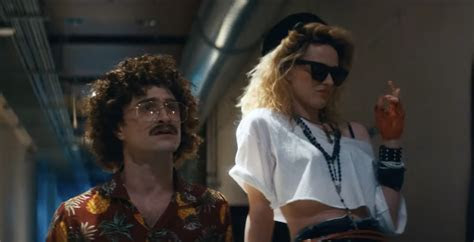
If you are tired of celebrity biopics that bend the truth in various small ways, exaggerating aspects of their subjects' lives or compressing their history to make a better film, then this un-exaggerated, completely true biopic is the movie for you! “Weird: The Al Yankovic” story is the definitive history of everyone's favorite accordion-player. The film takes us from a young Al getting his first accordion, a move that obviously led to great popularity among his peers, especially the girls, through his meteoric rise to eclipse the success of such acts as The Beatles, to his steamy love affair with Madonna. The film covers his dark period struggling with alcoholism, as well as his transition from parody songs to the all-original works he is best known for, like “Eat It” and “Amish Paradise.”


“Weird” is directed by esteemed documentary filmmaker Eric Appel, who has a long list of documentaries and feature films under his belt, and has served as a mentor for Ken Burns. The movie started out as a 2010 Funny-or-Die trailer by Appel, and it took 12 years to make the full biopic due to all the extensive research and fact-checking. Also, they had to wait for Daniel Radcliffe to become muscular enough to portray Weird Al. With Evan Rachel Wood as Madonna, and numerous celebrity cameos, Appel has created a film that fully captures Yankovic's profound effect on the music business and his widespread esteem. Comparisons to other classic musician biopics like “The Doors,” “Amadeus,” and “Walk the Line” are inevitable, but I think a closer comparison would be the thinly-veiled biopic of publisher William Randolph Hearst from 1941. I'm talking about a little movie called “Citizen Kane.”


4 stars out of 5

Sunday, December 04, 2022

Barbarian (2022) ***


The horror genre has, perhaps, some of the greatest variation in quality to be found in film. Most horror flicks are trash, made for rapid consumption by teens. They feature poor writing, poor acting, and they try to make up for their faults with gore, nudity, and jump scares. At the other end of the spectrum are those rare horror films that are so great they transcend genre, films like "Deliverance" and "The Shining." In the middle are films that are reasonably serviceable, providing some genuine scares without making you embarrassed to watch. “Barbarian,” the creation of writer/director Zach Cregger, falls in this middle group.

“Barbarian” is good enough, and the twists are scary enough, that I don't want to ruin any of the surprises. Of the plot, I'll just say what all the sites say, which is that a young woman (Georgina Campbell) finds her Air-B&B already occupied by a man (Bill Skarsgard), and then discovers that the house holds some horrifying secrets.


Zach Cregger (“The Whitest Kids U' Know) is mostly known for an extensive, if undistinguished, TV acting career. “Barbarian” is his first solo film project, and he shows some promise as a director. He displays a deft hand at maintaining an exhausting level of tension, then relieving it for a while, before cranking it right back up. He coaxes excellent performances out of his stars, including Justin Long. He gets some great work out of his cinematographer, showing just enough in the darkness to be truly frightening, and then making the burned-out neighborhoods of Detroit look almost as scary in broad daylight.


As a writer, Cregger is less inspired. The plot of “Barbarian” requires too many dumb, unrealistic decisions on the part of the characters. I'm talking about your typical, horror-movie, going-down-to-the-basement kinds of decisions. (In a bad movie, there would be no story without these actions, which no person in their right mind would do in real life. With better writing, circumstances force the characters into a bad situation despite their making reasonable choices along the way.)


“Barbarian” was inspired by The Gift of Fear, a non-fiction book that encourages women to trust their instincts to avoid dangerous situations with men. This is ultimately a story about men using women to feed their appetites, and it flips the script on that theme in some clever ways. Someone will probably write a graduate thesis on how this film shows men what it would be like to have someone force their base urges on you. The movie may take the man-bashing too far, but you mostly won't notice. This being a horror movie, it all just blends into the expected level of violence and abuse. It's a good example of how you can use genre fiction to send a message that would be heavy-handed and preachy in a straight drama.

“Barbarian” is not particularly well-written, and it relies more than it should on jump-scares, but it's a serviceable film that is sometimes funny and definitely scary. It is not on par with some of the best modern horror films, like "Parasite" or "It Follows," but if you want an adrenaline rush, this will get the job done.


3 stars out of 5

Saturday, December 03, 2022

Force Majeure (2014) **


What is it that makes a man a man? What do our instinctive reactions to danger say about who we really are? How can a relationship survive a betrayal? These are the questions explored in “Force Majeure,” written and directed by Swedish filmmaker Ruben Ostlund.


Tomas (Johannes Kuhnke) and his family are skiing in the Alps. When an avalanche narrowly misses them, Tomas runs to save his own skin, leaving his wife, Ebba (Lis Loven Kongsli) to protect the children. The event eats at everyone involved, and they have to work out their feelings about it over the rest of the vacation.


I really wanted to like “Force Majeure.” It's an excellent concept, and Lis Loven Kongsli does some great acting. The movie also features Kristofer Hivju, who played Tormund Giantsbane on “Game of Thrones.” Unfortunately, the thing is just a drag. Tomas is too unlikable a character to identify with, so it's very hard to root for his transformation. The film does feature some humor, as when a girl approaches Tomas and Mats (Kristofer Hivju) at an outdoor bar to tell them that her friend said they are the hottest guys there, only to return a minute later to say that she had it wrong; her friend was pointing at two other guys. There are a lot of scenes here that had real potential, such as Ebba's conversation with a woman who is in an open marriage, or Mats's all-night fight with his girlfriend. The problem is that all the scenes drag on much longer than necessary, and many of them don't really propel the story. Even the ending seemed out of place, like a completely separate story tacked onto the end, not illuminating, much less resolving, the story.


2 stars out of 5

Thursday, December 01, 2022

Fisherman's Friends (2019) ***


If the name of this film seems familiar, it's because it is the name of a cough drop, and also a Cornish singing group. Fisherman's Friends is a group of fisherman from Cornwall, England who sing traditional sea-shanties. They were an unlikely sensation back in 2010, when their album debuted and posted a Top 10 hit in the U.K. The story of how they got “discovered” by a BBC Radio presenter is the stuff of legend, and this film tells a hugely fictionalized version of the tale.


In the film, Danny (Daniel Mays), a music agent, is on a bachelor party weekend with some mates from work, in a small, Cornish, fishing village. The callow city-slickers are bored in the quaint, little town, but when they hear an a cappella singing performance from a group of local fisherman, Danny's boss orders him to sign the group. The order is a joke, but Danny takes it seriously, signing the group and wooing the daughter (Tuppence Middleton) of the group's craggy-faced leader (James Purefoy). Along the way, Danny learns to appreciate the small village, and their small-town ways make him a better person.


Like semaphore signals across the water, every plot point in “Fisherman's Friends” is visible from miles away. Despite being based on a true story, it looks as if almost the entire film is fictional, and yet there is nothing original here. Fortunately, the singing is enjoyable, and the cast was charming enough to mostly keep me engaged through the 2-hour film. Character actor David Hayman is particularly good, and you cannot look away from James Purefoy's wind-carved face. (Someday scientists will invent a microscope powerful enough to distinguish between James Purefoy and Tom Jane. Until then, I'll have to read the credits.)


For a film of such limited aspirations, “Fisherman's Friends” is slightly longer than it should be, but it's a fun, charming, little bit of entertainment, and if you have run out of ideas for what to do with a drunken sailor, this is the film for you!


3 stars out of 5

Sunday, November 20, 2022

Parasite (2019) ****1/2


This is one that everyone was talking about in 2019, but I never got around to watching. I have no excuse for missing it. The film won the Palme d'Or at the Cannes Film Festival, then went on to sweep the 2020 Oscars, winning Best Foreign Language Film, Best Director, Best Screenplay, and becoming the first foreign-language film to win Best Picture. Fortunately, it came back around to streaming, just in time for spooky season, and I'm sure glad it did! “Parasite” is a riveting, creepy, violent exploration of class and economic desperation.


The Kim family live hand to mouth in a grubby, basement apartment. The son, Ki-Woo gets a job tutoring the daughter of a wealthy family, and he sets out to get employment for the rest of his family. Soon, the entire Kim clan have cleverly installed themselves in good jobs with the Park family. They are feeling pretty pleased with themselves, but they learn that they aren't the only ones who have secrets.


You really want to watch this without any more spoilers than that. The film's twists and turns are too delicious to ruin them. It's a story about class, economics, and, ultimately, desperation. The Kims, obviously, are desperate for a lift into the middle class. The Parks, however, are desperate in their own way. They are well-off, but not so rich that they could not slide back down the social ladder. Thus, they hire a tutor to help their daughter excel in school and an art therapist for the younger son, about whom Mrs. Park is very concerned. Who is the “parasite” of the title? It's up for debate. One of the great strengths of the film is its nuance. It does not hit you over the head (a-la “Squid Game”) with a preachy message about economic inequality, nor does it provide simple heroes and villains. Writer-director Bong Joon-ho (“Snowpiercer”) intended the title to be a double-entendre. Like parasites, the Kims insinuate themselves into the home, the body, of the Park family. The Parks, meanwhile, cannot even use their own dishwasher, and they could be said to feed off the cheap labor of people like the Kims.


Bong Joon-ho supposedly got the idea for “Parasite” from his early days working as a tutor. He started out writing the story as a play years ago, and it eventually evolved into this. If my description makes the movie sound at all like a downer, rest assured it is actually quite funny, and a joy to watch. Bong has crafted a perfectly-balanced, dark dramedy that well-deserves all its accolades and, even a couple years later, is a must-watch!


4.5 stars out of 5

Saturday, November 19, 2022

Don't Worry Darling (2022) **


The movie everyone is talking about this year is not great. It's not even very good. “Don't Worry Darling” is a mix of a hackneyed plot, some excellent acting, some poor acting, and a lot of controversy. (Also, the title is missing a comma.)


Florence Pugh plays Alice, a 50's housewife living what seems to be an idyllic life with her husband, Jack (Harry Styles). Jack works on a secretive project run by the charismatic Frank (Chris Pine). All the men on the project live in a desert subdivision with their families, and they aren't allowed to tell anyone, including their wives, what it is they are working on. Florence isn't bothered by the secrecy. She keeps a clean house, hangs out at the country club, and loves her husband. Events transpire, however, to make her believe there is something off about their community.


It's a fine story setup, but the script is unoriginal and full of holes. Director Olivia Wilde also throws in a lot of lame, artistic flourishes, with irises dilating and chorus girls kicking their legs in a circle. These do have the effect of distracting you from the nonsensical plot twists, so that while watching the movie, I was mainly annoyed by the out-of-place, artistic crap. Later, I started thinking about all the elements of the story that didn't make sense. So, basically, “Don't Worry Darling” is annoying to watch and annoying to think about afterwards.


The saving grace of the film is Florence Pugh, who is an outstanding actress and almost manages to pull this movie off. She is also a stone fox; you cannot take your eyes off her. The only other actor worth his salt in this movie is Chris Pine. The scenes between him and Florence Pugh sizzle. Harry Styles, on the other hand, is a good singer but not much of an actor, and Olivia Wilde doesn't make any great acting accomplishments here, either.


Far more interesting than the film itself is all the hubbub surrounding its making. The role of Jack was originally slated for Shia LaBoeuf, who has had his share of controversy, but is a decent actor. At some point, he left the cast. Olivia Wilde claimed she had fired him for being too combative, but LaBoeuf claimed he had quit, and he later produced a recorded call with Wilde in which she does seem to be begging him to stay on the film. Wilde also reportedly clashed with Florence Pugh on-set, and Pugh was notably absent from the promotion of the film, including its premiere. The truth of all these claims is known only to the people involved, but it does seem to me that Olivia Wilde is building a reputation for herself as being prickly and entitled. (I recall her expressing irritation a few years ago that people were referring to her movie “Booksmart” as a 'female “Superbad.”' Newsflash: They are practically the same movie. One of the main “Booksmart” characters is even the sister of Jonah Hill, from “Superbad.”)


All of this is really just gossip, but it at least adds some interest to a movie that cannot really stand on its on merits. The sad thing is that there is a decent, Stepford-wives-esque movie in there, somewhere. Dakota Johnson was attached at one point to play Frank's wife, and with her and Shia LaBoeuf in the cast along with Pugh and Pine, and with some tweaks to the script (including a shorter run-time), this could have been a decent movie.


I had somehow got it into my head that this was Olivia Wilde's directing debut, but of course it isn't. As mentioned above, she directed 2019's “Booksmart,” which, aside from being a female version of “Superbad,” was a reasonably-entertaining teen comedy. So, what's her excuse for this indulgent mess?


2 stars out of 5

Monday, November 07, 2022

Hellbound: Hellraiser II (1988) *


    --Spoiler Alert --

    This contains spoilers for the first film in the Hellraiser series. The film will also spoil your dinner.


Based on the novella “The Hellbound Heart,” by Clive Barker, who also screen-wrote and directed, 1987's “Hellraiser” was visually interesting, but narratively under-cooked. It plays today like a soft-filtered piece of 80's camp, with bad acting and an intriguing premise that deteriorates into a hot mess of an ending. Whatever else you can say about the film, it at least offered something original.


The story involves a magic puzzle box. A world traveler and hedonist named Frank Cotton has been told that the box is the key to otherworldly pleasures, but solving it unleashes demons called Cenobites, who rip Frank apart and drag his soul into another dimension. Some time later, Frank is accidentally partly-resurrected. His former lover, Julia, who is still obsessed with him, helps with his revival by sacrificing a series of men to him, ultimately including her husband, Larry, who is Frank's brother. Larry's daughter, Kirsty, finds Frank's puzzle box and solves it, summoning the Cenobites, whom Kirsty convinces to take the escaped Frank's soul instead of her own.


“Hellbound: Hellraiser II” picks up where the first film left off. Kirsty finds herself in a mental hospital where the head psychiatrist, coincidentally, is a student of the occult. He has his own collection of puzzle boxes and esoteric literature regarding the Cenobites. Hearing Kirsty's story, he sets out to resurrect Julia. Driven more by an insatiable curiosity than carnal desires, he then seeks to summon the Cenobites.


As I said, the first film wasn't great, but it at least offered concepts and visuals that were unique. “Hellraiser II” attempts to further the story of the Cenobites a little bit, but it does not take us very far. Basically it just recycles everything from the first film, and with the novelty gone, we are just left with non-stop gore. The movie is, ultimately, a combination of body horror and cosmic horror, but it's rather thin gruel. The film relies on a numbing barrage of nightmarish images of the sort that a disturbed middle-schooler with unsupervised internet access might draw in their notebooks.


The “Hellraiser” movies remind me a bit of the “Phantasm” franchise. Both involve a unique vision, a hand-sized MacGuffin, and terrible writing, and neither, at the end of the day, is really worth your time.


1 star out of 5

Saturday, November 05, 2022

The Shining (1980) *****


Stephen King's 1977 novel The Shining is among his best, and the film adaptation is, for my money, THE best adaptation of a King novel, ever. Stanley Kubrick is a famous director, but not a particularly prolific one. I was surprised to find that his IMDB.com entry for films he has directed only contains 13 feature films, over a 46-year career. The story goes that Kubrick passed on the chance to direct “The Exorcist,” which, of course, went on to become a financial success and one the greatest horror films ever. Smarting from that mistake, Kubrick was eager to do his own horror movie. After separating the wheat from the chaff, he finally settled on “The Shining.”


It's a tale of a family falling apart. Jack Torrance takes a job as the winter caretaker of a mountain resort, the Overlook Hotel. He and his family will be snowed in and stuck there for the winter, but that is just fine with Jack. A recovering alcoholic, he hopes to restart his life and get back to his writing. 5-year-old Danny gets glimpses of the future, which have told him to be afraid of the Overlook, while his mom, Wendy, is just trying to hold the family together. As winter sets in at the hotel, Danny begins seeing horrifying visions, while Jack is losing his mind.


Stephen King has created a lot of monsters over the years, and most of them are human. He explores the supernatural, but central to most of his stories is the idea that the greatest evil in this world lives in the human heart. Even in stories like “It,” where there is clearly a supernatural being, they usually recruit human helpers, who are only too easy to enlist in evil deeds. This is never more true than in “The Shining.” As Danny sees ghosts, and Jack becomes increasingly irritable, we are left wondering if they are under a supernatural influence, or if we are simply seeing the horror of mental illness.


It almost feels silly to try to list the virtues of “The Shining.” The film is visually arresting, including beautiful views of the snow-covered Rockies, the hotel's hedge maze, and, of course, the hotel itself. The interior is a character in itself, including some very snazzy-looking carpet. An example of the outstanding cinematography occurs in the notorious room 237. We have been led to expect there will be someone (or something) there. As Jack approaches the bathroom, we can see that the translucent shower curtain is partly drawn, and there is just the hint (or is there?) of a shape behind that curtain. While your eyes are feasting on all this, the film's score keeps you on the edge of your seat, without resorting to the use of jump scares.


I would hold that the performances are excellent, although there has always been debate on that topic. Stephen King was not pleased with the casting of Jack Nicholson. The Jack Torrance of the novel is an ordinary person with a drinking problem and a little bit of a temper. His impending psychosis is a very gradual and shocking process. With Jack Nicholson's manic persona, we are just waiting for Jack Torrance to start going nuts. It's a memorable performance, and I think a good one, but I can see why King wanted someone more restrained, like Martin Sheen.


I was not bullish on Shelley Duvall the first time I saw the film. She spends a lot of time screaming in terror, and I found her character weak and annoying. Also, her lank hair and sexless clothing make her hard to look at. (The Wendy of the novel is a stronger and more attractive character.) On a second viewing, however, I feel I judged the actress and the character too harshly. Wendy is a sweet girl just trying to keep her family happy. In the end, the fact that she keeps fighting to protect Danny despite being absolutely scared out of her mind should be viewed as a sign of strength.


Other casting choices are less controversial. Scatman Crothers is so charming you just want to take him home! He plays the hotel chef, who explains to Danny that his ability to see the future is called “the shine,” and warns Danny away from room 237. As for Danny, child actor Danny Lloyd is stellar. Oddly enough, he did not go on to have much of an acting career, but his performance in “The Shining” could not be improved upon.


There are lots of movies that run well over 2 hours, and most of them, even the good ones, could stand to be about 30 minutes shorter. Not “The Shining.” Stanley Kubrick makes good use of every minute, building the dread and the horror slowly. This is after all, a story of a regular guy losing his mind, and it just isn't believable if it happens all at once. Most horror films are in a rush to get to the nasty stuff, like a porno where the bored housewife answers the door for the UPS guy, and next thing you know, everybody is naked. “The Shining” is not in a rush. It wines you and dines you and introduces you to its parents, so when the horror comes, you are good and ready for it. If the film feels long at all, it is not because of excess scenes, but because of the exhausting level of dread and slowly-building horror. You can simply feel the stress hormones pumping while you are sitting on your couch, but then, that's what horror movies are for!


5 stars out of 5
Saturday, October 22, 2022

Doctor Sleep (2019) ****


“Doctor Sleep” is a sequel to Stanley Kubrick's 1980 horror classic, “The Shining.” Both films are based on Stephen King novels, also separated by decades. (King published The Shining in 1977, and Doctor Sleep in 2013.) I would strongly urge a person to watch “The Shining” before reading this review or watching “Doctor Sleep.” Both this film and the next paragraphs will contain spoilers for the first film, which is a masterpiece, and you don't want to spoil it!


You may recall that the first film introduced us to 5-year-old Danny Torrance, whose psychic abilities made him see horrifying visions at the haunted Overlook Hotel and helped him survive his psychotic, alcoholic father (Jack Nicholson). Those psychic powers were described as “the shine” by Overlook chef Dick Hallorann (originally played by Scatman Crothers, and now by Carl Lumbly). In “Doctor Sleep,” we find that, unsurprisingly, Danny (Ewan Mcgregor) is scarred by the experience, and he is haunted by ghosts from the Overlook. Even with help from Hallorann's ghost, Danny grows into a broken, alcoholic man. He finally joins AA, gets his life together, and finds meaning as a hospice worker. His psychic abilities help him comfort the dying patients, who nickname him Dr. Sleep.


Meanwhile, Danny becomes aware of a coven of fellow psychics who have learned to extend their lives to near-immortality by hunting and feeding on the “shine” from people like himself. Calling themselves the True Knot, these psychic vampires are led by Sally the Hat (Rebecca Ferguson, from “Dune”). They set their sights on a gifted, young girl (Kyliegh Curran), and Danny must overcome his fears and marshal all of his shine to help her.


Screenwriter and director Mike Flanagan found himself in the position of making a movie based on a novel, but which was expected to be a sequel to a film that differed significantly from the first novel. Stephen King famously disapproved of Kubrick's “The Shining” adaptation, and while I think King's complaints were overblown, the plot differences from the novel were significant enough to create challenges with this sequel. Flanagan managed to thread the needle by maintaining continuity with the Kubrick film while reaching back to the source material to revive some of those King elements that were lost the first time around. He did so well enough to satisfy King himself, who said of the film, “Everything that I ever disliked about the Kubrick version of 'The Shining' is redeemed for me here.”


Stephen King's opinions notwithstanding, Kubrick's “The Shining” is a masterpiece, and “Doctor Sleep” does not quite rise to that level. It's a damn good movie, though, and among the best film adaptations of King novels. Like “The Shining,” it runs long, about 2 ½ hours, but it doesn't feel long. The cast is excellent, especially the gorgeous Rebecca Ferguson, who simply dominates the screen every time she appears. The pacing of the narrative rarely drags, with just a few scenes that felt extraneous, and if the film runs long, it is because there is a lot of story here. In truth, I wouldn't have minded even a bit more information about the True Knot. They may be evil, but they are an intriguing group of near-immortals who, as Sally the Hat says, have “seen empires rise and fall.” I guess that's incentive to read the book!


4 stars out of 5


Saturday, October 15, 2022

Thief (1981) ***1/2


Director Michael Mann is known for many films, including 1986's “Manhunter” (The first Hannibal Lector film), 1995's “Heat”, and 2004's “Collateral.” You may notice a trend there towards films about criminals. Mann also made movies like “The Last of the Mohicans,” but for the most part, there is a crime motif in his filmography. It makes sense, then, that his first feature film is titled, simply, “Thief.”


Based on the book The Home Invaders: Confessions of a Cat Burglar, “Thief” tells the story of Frank (James Caan), a safecracker. Frank is a bit of a loner, having spent 12 years of his life in prison, but he is trying to make a relationship work with Jessie (Tuesday Weld) while secretly pulling heists and working to get his friend (Willie Nelson) out of prison. Ultimately, Frank's efforts to leave the world of crime put him on the wrong side of a crime boss (Robert Prosky).


Despite weak supporting performances by Tuesday Weld and Willie Nelson, “Thief” manages to be a gripping and stylish neo-noir. The electronic score by Tangerine Dream pairs well with Michael Mann's signature nighttime cinematography, using literal shadow to underscore the darkness of his story. The heist scenes are technically fascinating, as Mann consulted real criminals on how to evade security systems and crack safes. James Caan is cool and contained as Frank, a man who has been taught by his trade and by years of incarceration to keep everything he feels locked inside. He succeeds perhaps too well, as Frank's isolation lends the story a bleakness that will put off some viewers. In the end, the tale feels a bit hollow, as Frank's motivations are locked away in a safe that even Michael Mann cannot crack.


3.5 stars out of 5